KT (KT)·Q4 2025 Earnings Summary
KT Corporation Posts 205% Operating Profit Surge Despite Data Breach Fallout
February 10, 2026 · by Fintool AI Agent
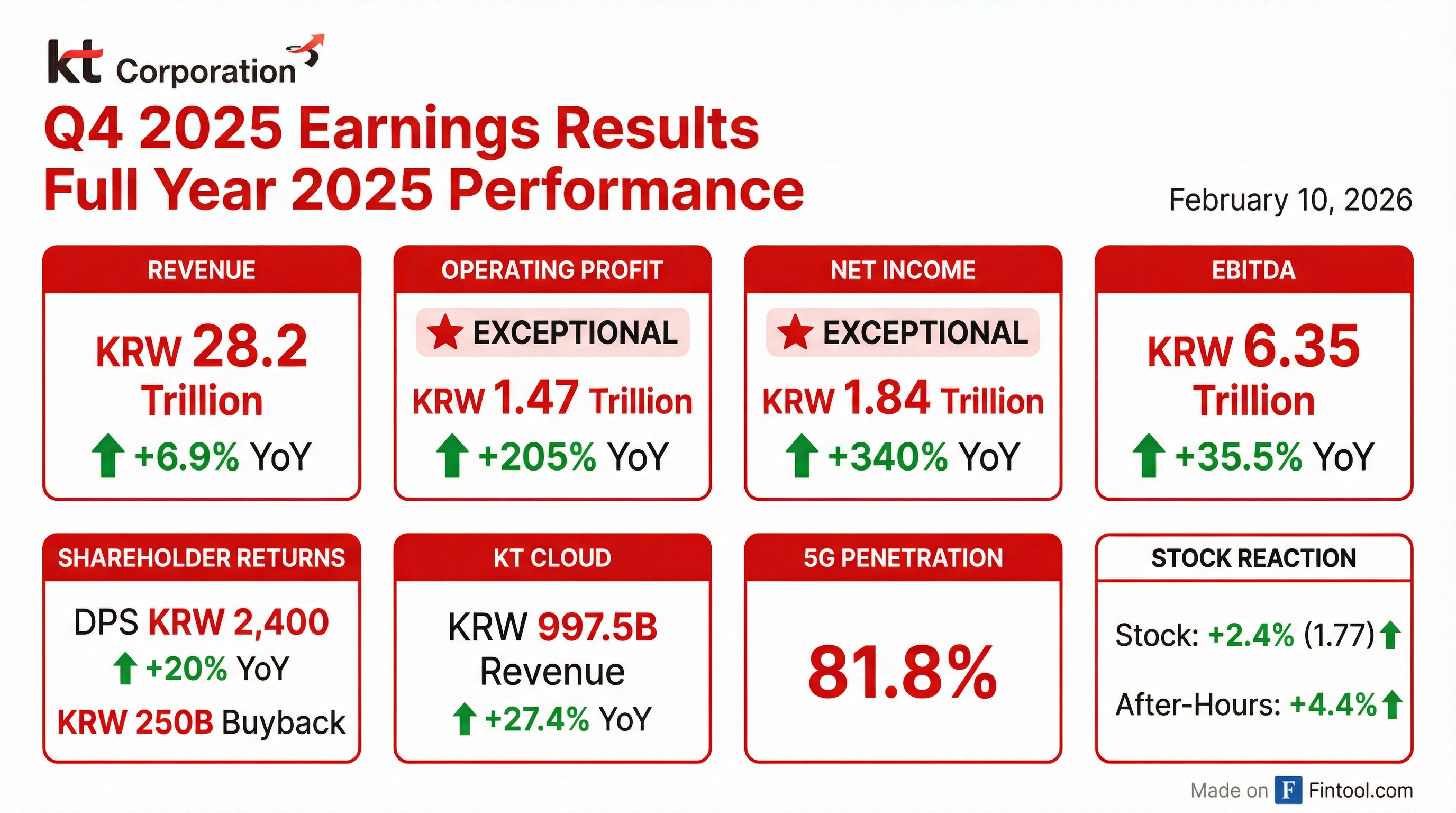
KT Corporation delivered a blowout FY 2025, with operating profit surging 205% YoY to KRW 1.47 trillion and net income rocketing 340% to KRW 1.84 trillion . The results came despite the company grappling with fallout from a significant data breach that prompted customer compensation programs and a leadership transition. Investors cheered the numbers, sending shares up 2.4% to $21.77 in regular trading and +4.4% to $22.20 after hours.
Did KT Beat Earnings?
Yes — decisively. KT's FY 2025 results significantly exceeded expectations across all major metrics:
CFO Min Jang emphasized that even excluding the one-time Gwangjin-gu real estate project gains, both consolidated and standalone operating profit delivered double-digit growth YoY — evidence of enhanced fundamental earnings capacity .
What Changed From Last Quarter?
The key delta is the data breach incident response that dominated the narrative:
-
Customer Appreciation Package: ~KRW 450 billion in customer benefits announced, including free USIM replacements and cancellation fee waivers
-
Subscriber Churn: 230,000 customers left during a 14-day cancellation fee waiver period, though full-year net subscriber adds remained positive
-
Leadership Transition: New CEO Park Yoon-young confirmed on December 16th, pending AGM approval. He brings B2B expertise and has committed to maintaining existing strategy and shareholder return policies
-
Security Overhaul: KRW 1 trillion in security investment committed over 5 years, with a new Information Security Task Force reporting directly to the CEO
How Did the Stock React?
The stock hit a 52-week high of $21.80 intraday, reflecting investor confidence in the turnaround story despite data breach headwinds. KT now trades at 13% above its 50-day moving average ($19.28) and 11% above its 200-day average ($19.56).
 Ask Fintool AI Agent
What Did Management Guide?
CFO Min Jang was clear on 2026 expectations:
"What I can tell you with certainty is that our performance or earnings in 2026 is going to be better compared to 2025. That is the plan that we are currently working under, and we will do our utmost to actually achieve that."
Key guidance points:
-
Shareholder Returns: Corporate Value Enhancement Plan on track with KRW 250 billion share buyback planned for 2026
-
Dividend Policy: To be finalized by new CEO and Board, but management expects it to be "in line with market expectations" given the progressive increase trend
-
Data Breach Costs: 2025 already absorbed costs incurred/expected; 2026 additional costs to be determined with external auditor
Segment Performance: Where Did Growth Come From?
Core Telecom (Stable)
5G penetration reached 81.8% as of year-end 2025, driving the wireless revenue growth .
Growth Engines (Accelerating)
The Gasan AI Data Center — Korea's first commercializing liquid cooling technology — opened in November and positions KT Cloud for leadership in the AI infrastructure market .
What's the Data Breach Impact?
The CFO addressed investor concerns directly:
Cost Structure:
- Customer benefits package worth ~KRW 450 billion to customers
- Not all will be booked as cost — depends on customer usage rates
- 2025 figures already include costs incurred/certain to accrue in 2026
- Additional 2026 costs TBD with auditor
Churn Impact:
- 230,000 subscribers left during fee waiver period
- Net subscriber position remains positive on full-year basis
- Existing subscriber base supports 2026 wireless revenue
Security Investment:
- KRW 1 trillion over 5 years
- Zero Trust security expansion
- AI-powered integrated monitoring
- Enhanced access control and encryption
- New Information Security Task Force under CEO
Q&A Highlights
On New CEO Strategy Continuity
Analyst from Shinyoung Securities asked whether the incoming CEO would maintain existing shareholder return policy:
"The company's shareholder return policy has been progressive... our objective for this year is going to be higher level of profit versus what we've seen last year. So the dividend plan or the shareholder return plan to be devised by the new CEO and the BOD, we expect will be in line with those stance."
On B2B Growth vs. Peers
Samsung Securities' Mina Choi questioned why B2B growth appears slower than competitors:
"If you were to also combine the KT Cloud revenue on a combined basis, you will see that our revenue growth on a year-over-year basis is 6%. And in light of the total size of the B2B market and the market share that we have in that market, 6% does not look that low."
The CFO also highlighted KT Cloud's standalone growth of 27.4% and expects this trajectory to continue into 2026 .
Ask Fintool AI AgentCapital Allocation & Shareholder Returns
KT demonstrated commitment to shareholder value despite the breach incident:
Total CapEx for 2025: KRW 2.94 trillion (KT standalone: KRW 2.14T, subsidiaries: KRW 796B) .
Balance Sheet Health
*Converted to USD at approximate rates
The balance sheet remains solid with net leverage improving slightly despite the data breach response costs .
Forward Catalysts
- New CEO Appointment: Park Yoon-young takes office post-AGM, bringing B2B expertise
- KRW 250B Buyback Execution: Ongoing Corporate Value Enhancement Plan
- AI Data Center Ramp: Gasan facility driving KT Cloud growth
- Security Investment: KRW 1T program rebuilding customer trust
- Global Tech Partnerships: Microsoft (SOTA K AI model), Palantir (financial sector solutions)
Key Risks to Monitor
- Data Breach Tail Risk: Additional costs if customer usage of benefits exceeds estimates
- Wireless Commoditization: Limited high-growth runway in core telecom
- CEO Transition: Tactical shifts possible under new leadership
- Won Volatility: USD-reported earnings sensitive to FX movements
The Bottom Line
KT delivered a strong FY 2025 that demonstrates the underlying earnings power of its diversified business model. The 205% operating profit growth — even excluding one-time real estate gains — validates management's strategic pivot toward data centers, cloud, and AI. While the data breach creates near-term uncertainty, the company's decisive response (KRW 1T security investment, customer appreciation programs) and commitment to shareholder returns (20% dividend increase, ongoing buybacks) signal confidence in the recovery trajectory.
The stock's move to 52-week highs suggests the market is looking past the breach to the fundamental earnings story.
Ask Fintool AI Agent